For a brief moment, it looked like relief might be on the way. Federal regulators were finally talking tough about misleading prescription drug commercials. Some observers, even us, wondered whether the flood of pharmaceutical advertising might begin to ebb. Instead, many readers tell us the opposite is true: Drug Ads Everywhere is not just a catchy phrase—it’s their daily reality!
Why We Thought The Tide Was Turning Against Drug Ads Everywhere
Last fall, FDA Commissioner Dr. Marty Makary made headlines with an unusually blunt critique of direct-to-consumer (DTC) drug advertising. He wrote an article in JAMA (Sept. 12, 2025) titled:
“The FDA’s Overdue Crackdown on Misleading Pharmaceutical Advertisements”
He introduced his opinion piece this way, acknowledging drug ads everywhere were often misleading:
“Direct-to-consumer pharmaceutical advertising has evolved into a public health crisis demanding immediate action by the US Food and Drug Administration (FDA). For nearly 3 decades, pharmaceutical companies have exploited weak enforcement, flooding US consumers with promotional content that is often misleading.”
Dr. Makary went on to say that the FDA would be putting an end to deceptive and misleading ads that cost too much and had avoided proper oversight.
He ended with passion!
“The FDA’s new approach incorporates our guiding principles of gold-standard science and common sense. We believe decisions about prescription medications belong to patients and their doctors—not the advertising industry. With rigorous oversight of pharmaceutical marketing and enforcing fair balance requirements, we can help restore public trust.
“The regulatory neglect of the past 25 years ends now. Americans deserve better than a system in which pharmaceutical companies exploit regulatory loopholes while patients are misled and health care costs escalate. We will no longer tolerate deceptive practices that distort the patient-doctor relationship and waste billions of dollars in health care resources that could be better spent lowering drug prices for Americans.”
That message was directed to healthcare professionals. He went on to decry drug ads everywhere in The New York Times (Sept. 13, 2025):
“American drug advertisements are filled with dancing patients, glowing smiles and catchy jingles that drown out the fine print. It’s not education — it’s distraction by design. This is not how the practice of medicine is supposed to be.”
What Happened to the FDA’s War on Prescription Drug Ads?
Around the time of Dr. Makary’s announcement the FDA began sending warning letters to major drug companies—something we had not seen in years. It felt like a turning point. We were so optimistic.
We asked readers if they were noticing fewer commercials.
The response was swift and emphatic. If anything, they reported seeing more ads—not fewer.
Cynthia summed it up bluntly:
“When I saw the headline…my first thought was ‘you must be kidding!’ because the majority of TV ads in our market are either drug ads or personal injury lawyers. It’s relentless…The sheer volume of these ads must surely factor immensely into the cost of drugs in the US.”
That word—relentless—came up again and again.
Judith pointed out something we had not fully appreciated:
“I can tell you where all the prescription drug ads have gone…to YouTube. It seems to me that every other ad is for one drug or another.”
In other words, even if traditional TV advertising is shifting, it may simply be reappearing in new digital venues where regulation is harder to track.
Steve captured the frustration that many viewers feel about drug ads everywhere:
“If anyone says drug ads are less in quantity, they just need to watch the evening news. There is no reduction, and people are still dancing around. I turn the sound off on all TV commercials. Many times I can’t tell what their product is for because the video has nothing to do with anything. It’s about time the government got off its backside and started holding companies responsible for their garbage claims.”
Anne took me to task:
“Wishful thinking. There are just as many Pharma ads as ever. Especially if you watch the evening national news.”
Sue described something that disturbs us greatly about drug ads for schizophrenia:
“In the Portland, Oregon area there is no change at all. Shows are full of drug ads, mainly for Rinvoq and Skyrizi – nonstop. The latest one, which is pretty shocking, is for a new drug for schizophrenia. Should treatment for this condition be based on a patient’s seeing a drug ad? And of course, the patient is seen at a party having fun. Hope to see all drug ad ‘flowers’ wilt soon.”
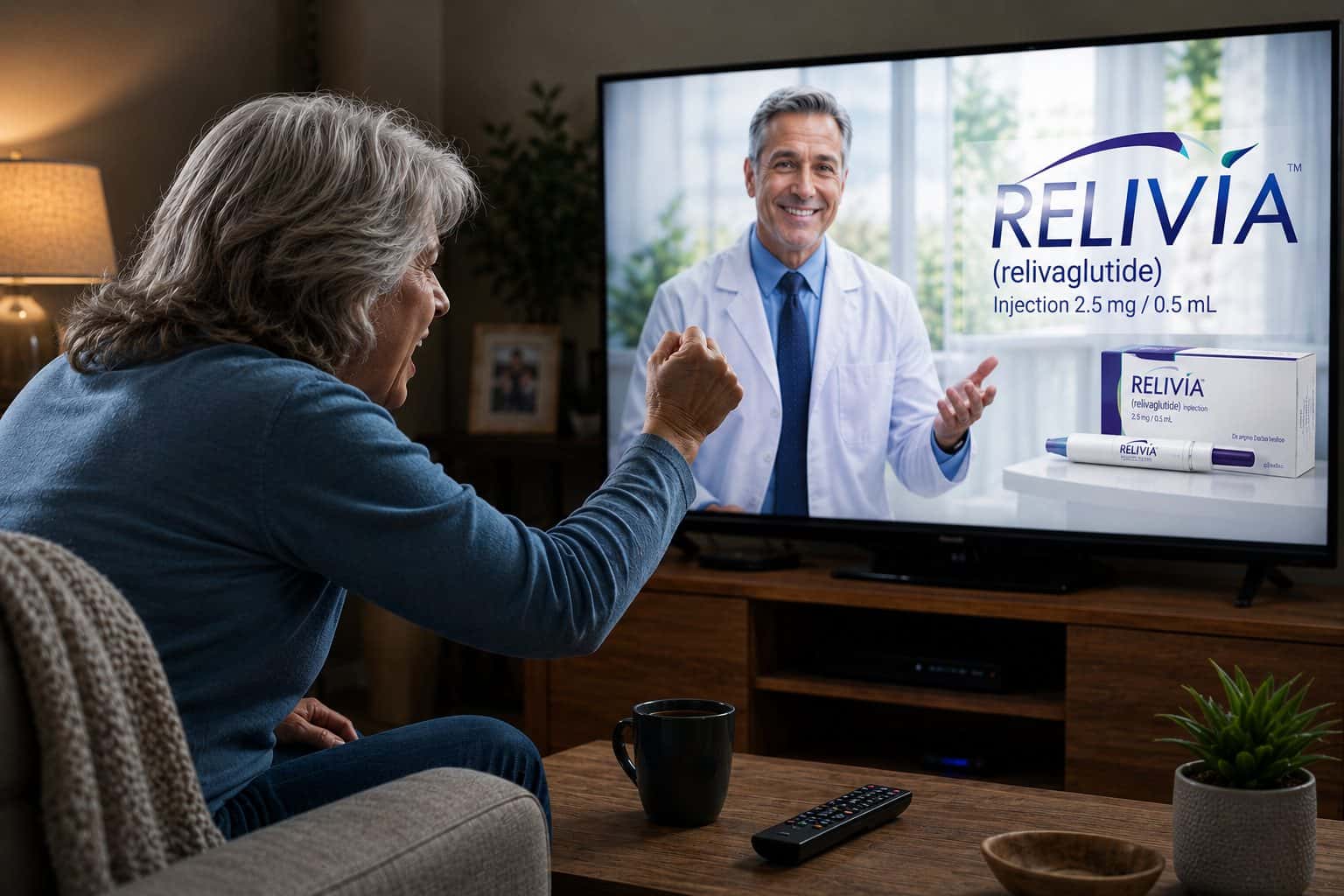
In short, from broadcast television to streaming platforms, readers are seeing Drug Ads Everywhere!
The Makary Moment…Now Over?
Fast forward to today.
Dr. Makary is out as FDA Commissioner. Whether he resigned or was pushed out matters less than what happens next. His aggressive stance toward drug advertising now appears uncertain at best.
He had argued that:
“Drug companies spend up to 25% of their budget on advertising…Those billions of dollars would be better spent on lowering drug prices.”
That message did not win him many friends in the pharmaceutical industry—or, arguably, in sectors that depend on advertising revenue. Without his leadership, it is unclear whether the FDA will continue pushing to rein in drug commercials. We would not bet on it.
Drug Ads Everywhere—and the Money Behind Them
To understand why we have lost confidence that the FDA will soon take action…follow the money.
We are not just talking about pharmaceutical companies. There is an entire ecosystem built around these commercials:
- Advertising agencies that design campaigns
- Production companies that film elaborate ads
- Actors, directors and crews who bring them to life
- Media buyers who place ads across TV, cable and digital platforms
- Networks, streaming services and social media platforms that profit from every placement
This is a multi-billion-dollar pipeline.
When so many powerful players benefit financially, it becomes extraordinarily difficult to shut the system down, even when critics argue that it distorts medical decision-making.
The acting FDA Commissioner who has taken over from Dr. Makary is an attorney who worked for an international law firm. Its clients included large companies serving the food, cosmetic and dietary supplement sector. One such client was Abbott Labs, maker of a very popular infant formula.
What Health Professionals Really Think
Our readers include a lot of health professionals, and their reactions are rarely positive.
Lisa writes:
“I am a former RN and my husband is a retired cardiologist. We hate these ads. They are a waste of money that could be put toward research or lowering drug costs.”
Karen offers a similar perspective from a different professional vantage point:
“Has it already been stated that physicians absolutely hate these ads? I am a retired professional pharmaceutical representative. For 35 years, I called on physicians and other prescribing practitioners. They told me that patients would see these ads on television and request the drug on their next visit.
“Too often the drug was not indicated for that patient and the clinician had to take the time to explain why not. In one example, a female patient 55 years of age asked for a prostate drug. Evidently, the commercial did not clearly state it was for men only. Let the MDs do their jobs.”
Another health professional joins the chorus:
“I’m sure it’s annoying to doctors to have to waste time explaining that the drug the patient saw on TV is not in their best interests. After being a pharmacist for 30 years, I absolutely despise drug advertisements. I especially hate the mini-musicals, where a supposed patient using the drug sings a song about it. Or the Wegovy advertisement where a bunch of overweight people walk down the street looking like they just won the top prize in Powerball. This needs to stop.”
Why Drug Ads Everywhere May Be Here to Stay
Only two countries in the world—the United States and New Zealand—allow direct-to-consumer prescription drug advertising. That alone should give us pause.
Yet despite decades of criticism, repeated calls for reform and now a high-profile (but short-lived?) push from the FDA, the commercials keep coming.
Why? Because advertising works. It drives patients into doctors’ offices asking for specific drugs. And let’s not forget: healthcare professionals watch television and YouTube, too. Those commercials are a lot less expensive than sending pharmaceutical company sales reps into hospitals and doctors’ offices.
The ads build brand recognition. And it generates enormous revenue, not just for drug companies, but for the entire media ecosystem.
Has Big Pharma Won the Advertising War?
It is too early to declare a final winner. There has been no official announcement that efforts to rein in drug advertising are dead. Policies can change. Leadership can shift. Pressure can build again.
But from where we sit today, the evidence is hard to ignore:
- The commercials have not disappeared
- Many viewers perceive more drug ads rather than less
- Dr. Makary’s regulatory push appears to have stalled
- The financial incentives remain overwhelming
That does not prove that Big Pharma has won the advertising war. But it does suggest they are not losing.
What You Can Do When You See Drug Ads Everywhere
Until something changes, patients are left to navigate this advertising landscape on their own.
Here are a few practical strategies:
- Be skeptical of emotionally appealing ads with happy actors and catchy music
- Count the number of dogs, children and smiles in each commercial
- Mute your TV or device when the drug commercials come on
- Ask your clinician whether a promoted drug is truly appropriate for you
- Inquire about alternatives, including older or less expensive medications
- Find out if there are nondrug alternatives that might be helpful
- Remember that ads highlight benefits—but often downplay risks and costs
Final Words
We had hoped that federal action might begin to curb misleading drug advertising. Instead, at least for now, the commercials continue—on television, online and across social media.
Drug Ads Everywhere remains more than a headline. It is the reality many Americans face every day. Whether that changes in the future remains an open question.
But if history, and money, are any guide, don’t expect the music, dancing, and smiling to stop anytime soon.
What do you think?
We would be grateful if you would add your thoughts to the comment section below. We will be sending this article to an executive we trust at the Food and Drug Administration. Perhaps if that person reads your comment below it will resurrect some degree of interest in curtailing prescription drug ads to consumers.
If you have any friends or family who might find this article meaningful, please send it along via email or social media. Just scroll to the top of the page and use the icons to spread this message far and wide. Thank you for your support.
Citations
- Makary, M.A., "The FDA’s Overdue Crackdown on Misleading Pharmaceutical Advertisements," JAMA, Sept. 12, 2025, doi: 10.1001/jama.2025.18197