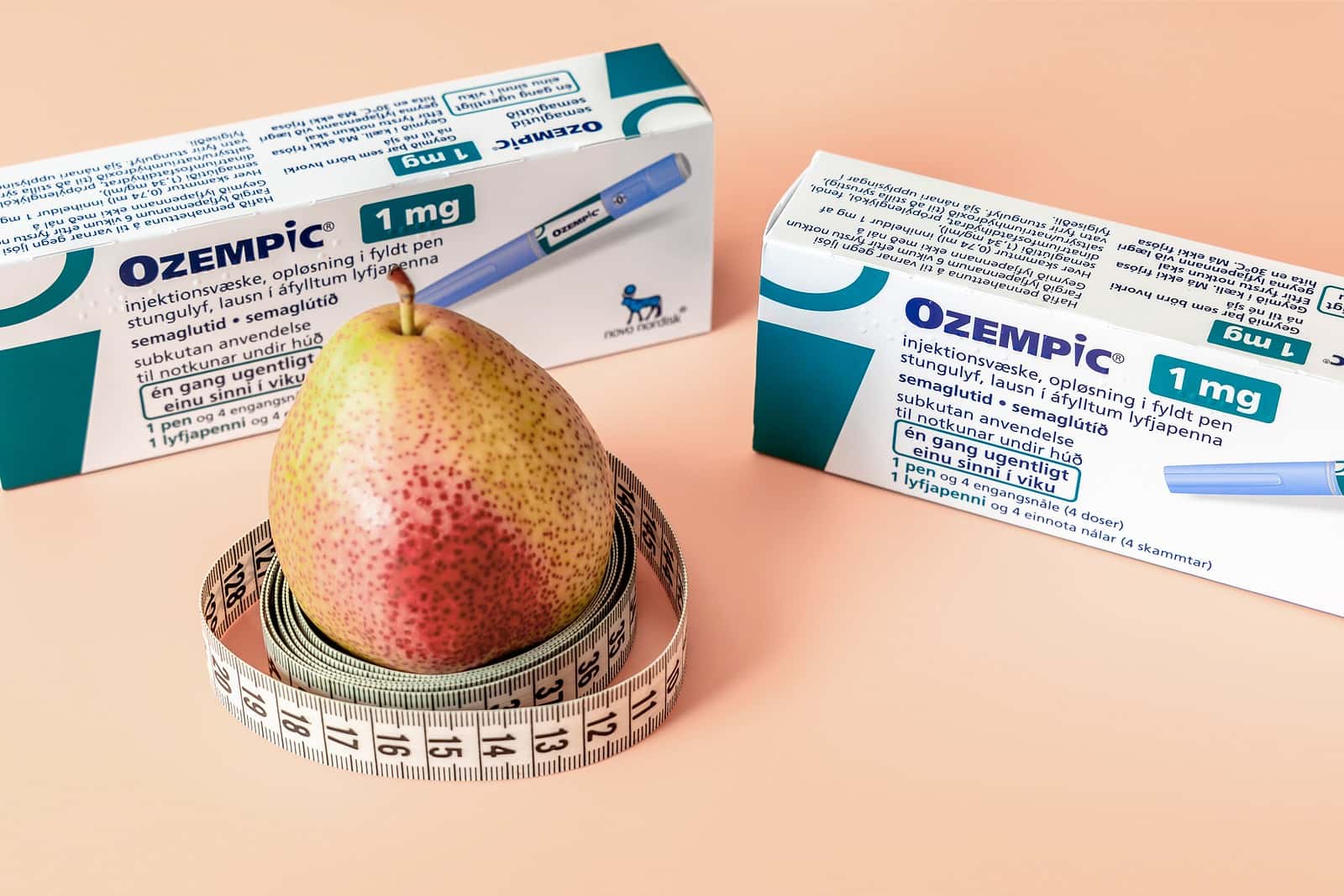
If you have been reading our newsletter, you know that semaglutide is one of the hottest medications in the pharmacy. For months, this self-injected diabetes drug was “Currently in Shortage.” Why would a brand name diabetes drug be so hard to get? You probably know the answer. It’s because doctors prescribe Ozempic for weight loss. That may be less common now that there are so many other options, including Wegovy and Zepbound, which are specifically for weight loss, rather than primarily for type 2 diabetes. Now that doctors have a lot of experience with these drugs, what have they learned about GLP-1 agonists, including Ozempic, for weight loss?
Will Ozempic for Weight Loss Undermine Muscle?
A recent report from the American College of Physicians Internal Medicine Meeting warned that taking such GLP-1 agonists might lead to loss of muscle. These include semaglutide (Ozempic, Wegovy), liraglutide (Saxenda, Victoza) and tirzepatide (Mounjaro, Zepbound).
The investigators reported that rapid weight loss with such medications might also lead to substantial muscle loss. This could be especially worrisome in older people if it leads to less strength and poor balance. There was a call for people on these medications to embark on extra exercise to build up strength.
Then we received this message from a reader:
“I read your column about GLP-1 drugs like Wegovy or Zepbound leading to muscle loss. You recommended strength training. Good luck with that.
“I am going to generalize here, but many people who are taking these new GLP-1 weight loss meds are not going to exercise or monitor their diets. They rely solely on the medication.
“As a former RN married to a Cardiologist, the many times he recommended diet, exercise and weight loss to help improve people’s lives and illnesses were ignored.”
Physicians have been recommending diet and exercise to help people lose weight for decades. We appreciate your husband’s advice and your perspective. For many people, simply being told to eat less and exercise more is not very helpful.
Here is one person’s response:
“I spent years trying to lose weight on different diets and going to the gym, sometimes four days a week when I could afford a membership. It took me six years on a group meeting-type diet plan to lose 100 pounds.
“Then I gained back 40 pounds when I quit the plan. Once I retired and went on Medicare, I worked out at home and tried to watch what I ate but it never helped.
“I have Type 2 Diabetes, stage 3 Kidney Disease, and both high blood pressure and high cholesterol, all controlled with medication. I started taking Ozempic in June of 2025, prescribed by my PCP to lower my A1C, which had crept up to 6.7, the highest it had ever been.
“Since then I have lost 31 pounds, a little at a time, and my A1C has gone down to 5.7 at my last lab report in March 2026. I’ve been lucky, as the only side effect I’ve had has been some constipation, for which I take an OTC supplement (I was already taking it due to a propensity for colon polyps, so I just had to increase the dose.)
“In addition, the Ozempic has made it so much easier to control the ‘food noise’ which caused me to eat things I didn’t need. My doctor increased my dosage of GLP-1 gradually, and I am now on 1 mg per week. I may go up to 2 mg, but as long as I am heading in the right direction, I’m not in a hurry.
“I try to do some type of strength class twice a week and cardio or walking four to five days a week. I had some physical therapy for a shoulder problem in 2025, and the therapist told me I am strong, so I guess it hasn’t weakened me too much. I am turning 76 next month and am very happy I started taking Ozempic. I just wish it had been available years ago.”
People’s Pharmacy readers offer additional perspectives below.
Eat to Live, Don’t Live to Eat!
This reader says that Ozempic for weight loss makes it possible to exercise:
Q. I have been on Ozempic for 12 weeks. In the beginning, I was very nauseated and fatigued, but I have lost 18 pounds.
After my injection, I am tired for two days. Then I feel pretty good the rest of the week. I am on a 0.5 mg dose, and it has significantly reduced my insatiable appetite. My portions are considerably diminished in size. I feel like I’m eating to live instead of living to eat. For the first time in my life, I can eat responsibly.
As a result, I have much more energy to exercise. I went from not exercising at all to about an hour a day, and I will forever be grateful for this medication. Food is no longer the focus of every waking moment. Instead, I can concentrate on the day.
Ozempic is the first medication that got me over my cravings for sugar. I’ve never been able to do that before. Since I am diabetic, that’s an amazing feat. I am looking forward to my next A1c.
FDA Approved Ozempic for Type 2 Diabetes
A. Thank you for telling us about your experience. The FDA approved Ozempic to help people with type 2 diabetes use diet and exercise to control their blood sugar more effectively. Evidence indicates it will also reduce the risk of cardiovascular complications. We trust that the next measurement of your glycated hemoglobin (“A1c”) will show that your blood sugar is in its proper range far more often than previously.
We are disappointed to learn that people who do not have diabetes are using Ozempic to lose weight. That has created shortages for those who depend on this medicine to control blood glucose.
Another reader is angry that doctors are prescribing Ozempic for weight loss and that her insurance company refuses to pay for this expensive diabetes drug.
Another Reader with Type 2 Diabetes Got Great Results on Ozempic
Q. I started taking Ozempic once a week about two months ago. Despite constipation and waves of nausea, I’m grateful to have it. I have very little appetite and have lost 11 pounds, though I wasn’t obese. My HbA1c has come down to 6.3 after being around 10.
Others I know have been told they can only take this drug for a limited time. Do you know about the time frame? In addition to Ozempic, I’m also on metformin.
A. Semaglutide (Ozempic) was initially approved for treating type 2 diabetes. The results you report are impressive. Lowering your HbA1c (glycated hemoglobin) to 6.3 indicates much better blood sugar control.
Because this drug and its twin, Wegovy, have received so much publicity about weight loss, there have been shortages. We are not aware of any reason to discontinue the drug other than side effects. If you stop taking semaglutide, you will lose both the advantages you have experienced and the adverse reactions.
To learn more about the benefits and risks of both semaglutide and metformin you may wish to consult our eGuide to Preventing & Treating Diabetes. This online resource can be found under the Health eGuides tab.
Can Insurance Companies Practice Medicine Without a License?
Q. I’m a type 1.5 diabetic (yes, it’s a thing), so I rely on insulin (as if I were a type 1) plus a couple of medications typically prescribed for type 2. I need all of them to keep my blood sugar under control.
However, when my doctor prescribed Ozempic, the insurance company claims people denied me twice. (Surely they have degrees in medicine…don’t they?)
I am disgusted to read that people who don’t even have diabetes are taking Ozempic just to lose weight! Amazing. Are insurance companies paying for this?
A. You certainly educated us about type 1.5 diabetes. It is also known as latent autoimmune diabetes in adults (LADA), and we were not aware of it previously.
Some medications used to treat the more common type 2 diabetes are not appropriate for your condition. However, Ozempic (semaglutide) is considered helpful.
How Can Insurance Companies Play Doctor?
We think it is unethical for insurance companies to practice medicine by second-guessing your doctor. It is unlikely that insurance is covering the cost of Ozempic for weight loss. If insurance won’t pay for an FDA-approved use such as diabetes it certainly should not pay for an unapproved use such as weight loss. The cost for one prefilled injectable “pen” of Ozempic could cost as much as $1,000.
This brand name diabetes drug hasn’t been approved to help people lose weight. Some doctors are prescribing it off label, however. As a result, current shortages are making it difficult for people with diabetes to access this medication.
Other Forms of Semaglutide
The same medicine, semaglutide, is prescribed as Wegovy for seriously overweight patients to help them lose weight. An oral version of semaglutide is also sold as Rybelsus to treat type 2 diabetes.
This reader wants to know why the FDA permits physicians to prescribe a diabetes drug for weight loss, especially when there is a shortage of both Ozempic and Wegovy.
Ozempic Is for Type 2 Diabetes…
Q. Because I have type 2 diabetes, I’ve been taking Rybelsus since April. My HbA1c is now down to 6.0 and I have lost close to 30 pounds.
There’s a lot of noise around using semaglutide (the ingredient in Rybelsus) for weight loss. I am sick of it! They are literally leaving those of us who truly need the medication for diabetes in the lurch, since there’s a shortage of the injectable medication.
Why would the FDA let doctors prescribe diabetes drugs for weight loss?
A. The FDA regulates drugs, but it has no authority over the practice of medicine. We think it is inappropriate for physicians to prescribe a critical drug that is in short supply to treat an unapproved condition.
This gets confusing, though, because semaglutide is prescribed under three different brand names.
First came Ozempic. The FDA gave this self-injectable formulation the green light in 2017 to treat type 2 diabetes. Novo-Nordisk launched an oral version, Rybelsus, in 2019, also for type 2 diabetes.
In 2021, the FDA gave the same self-injected form as Ozempic approval under the brand name Wegovy.
Wegovy is approved:
“…for chronic weight management in adults with obesity or overweight with at least one weight-related condition (such as high blood pressure, type 2 diabetes, or high cholesterol), for use in addition to a reduced calorie diet and increased physical activity.”
Oral semaglutide (Rybelsus) does not appear to be in short supply at this time.
Prescribing Ozempic for Weight Loss
Like you, we are dismayed that doctors would prescribe Ozempic for people without diabetes to lose weight. The drug can cause low blood sugar, abdominal pain, diarrhea or constipation, nausea and vomiting. There are also cautions about thyroid cancer, pancreatitis and gallbladder disease.
We have not seen any word of Rybelsus shortages at this time. The oral version of semaglutide has not received FDA approval for weight loss. Our hope is that doctors exercise restraint and do not prescribe this diabetes medication to people without this serious metabolic disorder.
To learn more about this controversial drug you may want to read our article at this link.
What Do You Think?
Should doctors be prescribing diabetes drugs for weight loss? Should insurance companies be allowed to second-guess doctors and deny coverage for a medicine a physician believes would be best for a particular patient?
Please share your thoughts in the comment section below.