
If you have been reading the headlines lately, you probably know that an mRNA vaccine to treat melanoma has just passed an important milestone. Moderna and Merck announced that their personalized cancer vaccine, intismeran autogene, significantly reduced the risk that high-risk melanoma would return or spread when it was combined with pembrolizumab (Keytruda). The Phase 3 trial involved 1,137 people whose melanoma had been surgically removed. This is the first mRNA-based cancer therapy to succeed in a Phase 3 clinical trial.
Cancer treatment has changed dramatically with the development of agents that harness the immune system. A combination of two drugs, ipilimumab (Yervoy) and nivolumab (Opdivo), works better than either one alone to treat melanoma, even in advanced stages. Doctors also use pembrolizumab (Keytruda), a PD-1 inhibitor, to treat melanoma.
Now oncologists may soon have another tool against this potentially deadly skin cancer. Unlike conventional vaccines designed to prevent infectious diseases, intismeran autogene is a personalized cancer treatment. It is created from the mutations found in an individual patient’s tumor and is intended to teach that person’s immune system to recognize and attack cancer cells.
Activating the Immune System = Immunotherapy
Scientists have dreamed for decades of creating vaccines vs. cancer. Years ago we interviewed scientists who were trying to come up with immunotherapy against cancer. You may find this interview of interest:
Show 1151: What Was the First Immunotherapy for Cancer?
Dr. William Coley developed the first immunotherapy for cancer more than 100 years ago. How did this bacterial toxin work to overpower tumors?
An mRNA Vaccine to Treat Melanoma
The latest research using an mRNA vaccine to treat melanoma suggests the dream of activating the immune system to fight cancer may finally be getting closer to reality.
Intismeran autogene uses messenger RNA, better known as mRNA, but this is not a COVID vaccine. After a melanoma is surgically removed, researchers sequence the tumor and identify mutations that distinguish the cancer cells from normal cells. A personalized mRNA treatment is then manufactured to provide the immune system with instructions for recognizing some of those unique tumor markers.
The idea is to create an immune response specifically targeted to the patient’s cancer.
The newest evidence comes from a large Phase 3 trial called INTerpath-001. It included 1,137 people with high-risk stage IIB through stage IV melanoma that had been completely removed surgically. Participants received either Keytruda plus intismeran autogene or Keytruda alone, without the personalized mRNA treatment.
At Last, a Big Announcement of an mRNA Vaccine to Treat Melanoma
On August 19, 2026, Moderna and Merck announced that the trial met its primary goal: adding the mRNA treatment significantly improved recurrence-free survival. It also significantly improved distant metastasis-free survival, meaning the cancer was less likely to spread to distant parts of the body.
There is an important caveat. The companies have not yet released the actual numbers showing how much better the combination performed in this Phase 3 study. Those results are expected to be presented at a medical meeting and submitted for publication.
There are, however, impressive long-term results from an earlier randomized Phase 2b trial involving 157 patients. Those findings were published in the Journal of Clinical Oncology (June 1, 2026).
After a median follow-up of five years, people who received intismeran autogene plus Keytruda had a 49% lower risk of melanoma recurrence or death than those receiving Keytruda alone. Their risk of distant metastasis or death was 59% lower.
Five-year recurrence-free survival was 68.8% with the combination compared with 49.1% with Keytruda alone.
That does not mean the vaccine reduced melanoma deaths by 49%. The primary measurement combined cancer recurrence and death into a single endpoint. Researchers reported an encouraging trend toward improved overall survival, but the study was too small to establish that conclusively.
If the larger Phase 3 results prove similarly impressive when the complete data are released, this could represent an important advance in the effort to treat melanoma.
Will the Letters mRNA Scare Some Patients?
Most Americans first encountered the term mRNA in connection with COVID-19 vaccines. That association may create an unusual challenge for this new approach to cancer treatment.
We have heard from many readers who remain deeply distrustful of COVID vaccines and of mRNA technology in particular. Some may therefore recoil when they discover that a potential new melanoma treatment is described as an “mRNA vaccine.”
But calling intismeran autogene an mRNA vaccine does not make it a COVID vaccine. Messenger RNA is a way of delivering biological instructions. In this case, those instructions are customized to mutations in an individual patient’s melanoma so that immune cells can learn to recognize the cancer.
Claims have circulated widely online that COVID mRNA vaccines cause unusually aggressive “turbo cancers.” Such claims have generated enormous controversy and mistrust, but convincing evidence that COVID vaccination causes such cancers has not emerged.
The irony is hard to miss. Some people who want nothing to do with an mRNA vaccine against an infectious disease may someday face a very different decision if they are diagnosed with a potentially lethal cancer and an mRNA-based treatment could substantially lower the likelihood that it will come back.
People should certainly ask hard questions about any new cancer treatment. They deserve complete information about benefits, risks, uncertainties and cost. But the letters mRNA alone tell us very little about whether a particular treatment works. That has to be determined from carefully conducted clinical trials.
What About Side Effects and Cost?
Pembrolizumab has a wide range of potentially serious adverse effects because stimulating the immune system can sometimes cause it to attack normal organs. In the earlier clinical trial, most treatment-related side effects with intismeran autogene were mild to moderate. Injection-site reactions, fatigue and chills were among those reported. The five-year follow-up found no new safety signals.
Another hard reality is likely to be financial. This is not an off-the-shelf vaccine. Scientists must sequence an individual patient’s tumor, select relevant mutations and manufacture a vaccine specifically for that person. Such personalization adds substantial complexity and cost.
The companies have not yet announced what intismeran autogene would cost. The FDA has also not yet approved it. Moderna and Merck say they plan to discuss regulatory submissions with health authorities following the successful Phase 3 trial.
Studying Cancer Drugs in Combination
The initial study of Yervoy and Opdivo in combination was presented at the meeting of the American Association for Cancer Research (AACR, Philadelphia, April 20,2015; New England Journal of Medicine May 21, 2015). Although oncologists were excited by the results at that time, in the decade since they have had time to compare other treatments. They are still searching for the best ways to treat melanoma, and the new vaccine seems to hold some promise.
Looking at Keytruda
At that time, Keytruda was also a newly approved cancer drug to treat melanoma. The FDA approved it for patients whose melanoma had not responded to Yervoy.
In the study, 830 patients with metastatic melanoma were randomly assigned to take Keytruda every two weeks, Keytruda every three weeks or the standard Yervoy regimen (New England Journal of Medicine, June 25, 2015). After a year, three-fourths of those who got Keytruda every two weeks were still alive. Just over half of those who got Yervoy had survived.
The study was stopped early because of the significant survival benefit. Keytruda was also associated with fewer side effects than Yervoy.
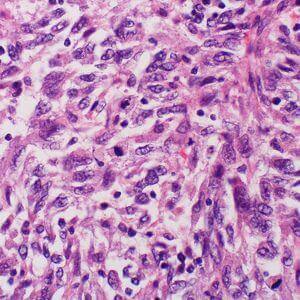
photo credit: Yale Rosen https://www.flickr.com/photos/pulmonary_pathology/ cc license cropped
https://www.flickr.com/photos/pulmonary_pathology/5601356718/
Lung Cancer Benefit
In another study, Keytruda showed promise against hard-to-treat non-small cell lung cancer.
Although we are still far from curing cancer, the new immunotherapy drugs offer exciting benefits, especially in patients whose genes make them particularly responsive to these medications.
These results are exciting, but there are concerns about the very high price of these drugs. Can individuals or even society as a whole afford them, or will they send the health care system into bankruptcy? We wrote about this topic here.
Final Words
Immunotherapy seems to be the wave of the future when it comes to hard-to-treat cancers. Whether it is an mRNA vaccine to treat melanoma or CAR-T against multiple myeloma, scientists are attempting to turn on our own immune systems to fight malignancies.
There are pros and cons of such treatments. They can, in some cases, prolong survival substantially. But they do not work for everyone. They can also lead to some very serious complications when the immune system overreacts.
There is also the cost factor. Drug companies are charging extraordinary amounts for these treatments. It is not clear that our health care system can withstand the financial burden these treatments are creating.
Citations
- Khattak, A., et al, "Intismeran Autogene Plus Pembrolizumab Versus Pembrolizumab Alone in High-Risk Resected Melanoma: 5-Year Update of the Randomized Phase IIb KEYNOTE-942 Study," Journal of Clinical Oncology, June 1, 2026, DOI: 10.1200/JCO-26-00835
- Postow MA et al, "Nivolumab and ipilimumab versus ipilimumab in untreated melanoma." New England Journal of Medicine May 21, 2015. DOI: 10.1056/NEJMoa1504030
- Robert C et al,, "Pembrolizumab versus ipilimumab in advanced melanoma." New England Journal of Medicine, June 25, 2015. DOI: 10.1056/NEJMoa1503093