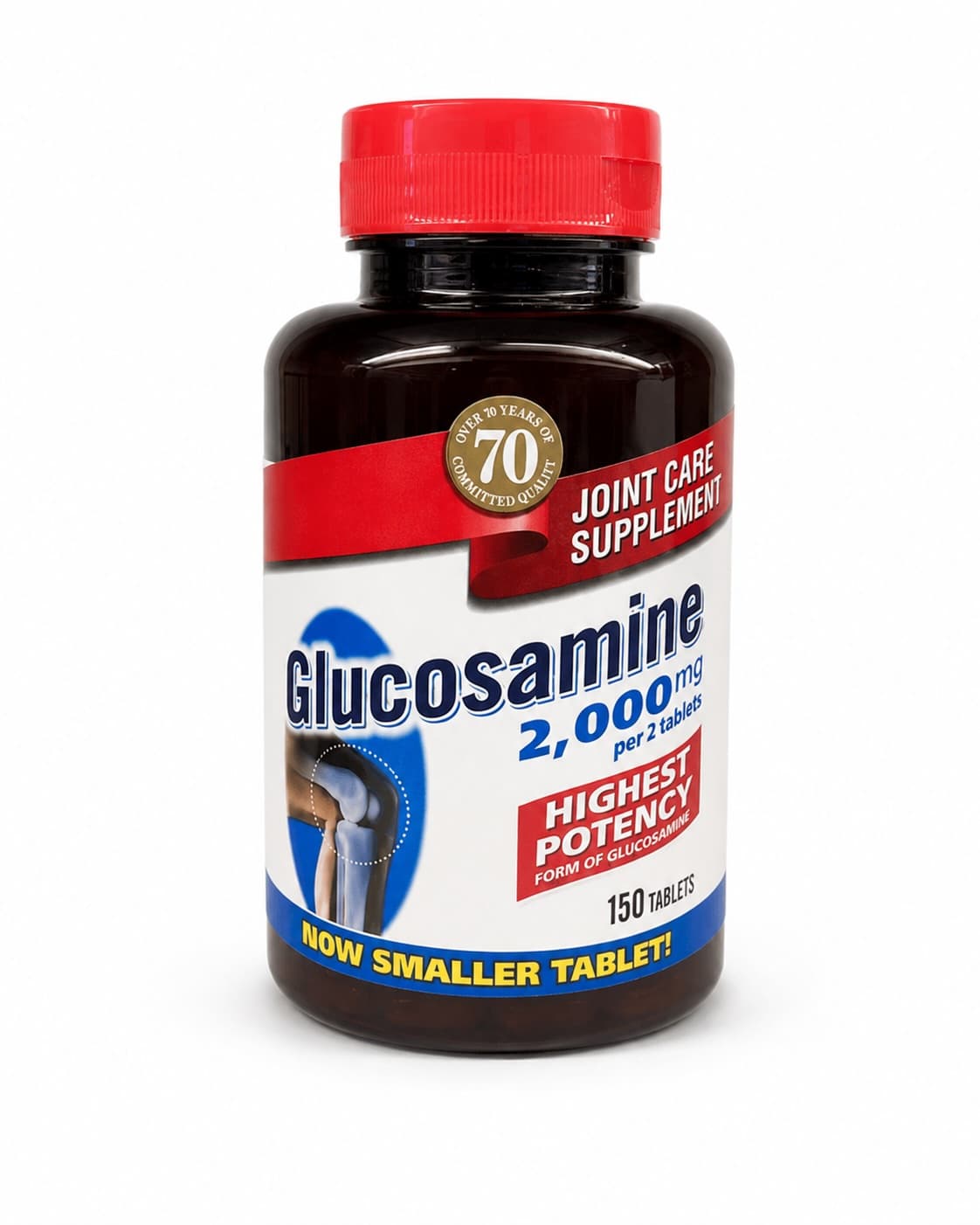
For decades, glucosamine has been one of the most popular dietary supplements for osteoarthritis. Many people take glucosamine sulfate alone or together with chondroitin in hopes of easing joint pain and improving mobility. Now a startling new study in the journal Nature Metabolism (June 9, 2026) raises a troubling question: could glucosamine be harmful for people with Alzheimer’s disease or mild cognitive impairment? The investigators lead us to suspect that glucosamine and dementia are a bad combination.
New Research Raises Concerns About Glucosamine and Dementia
Scientists recently reported that abnormal glycan metabolism may play an important role in Alzheimer’s disease. In experiments published in Nature Metabolism (June 9, 2026), researchers found that mice genetically engineered to develop Alzheimer’s-like brain changes experienced worsening cognitive problems when given glucosamine. The supplement increased glycan production in the brain and appeared to accelerate disease-related changes.
Here is how the researchers introduce their study:
“Alzheimer’s disease (AD) is a complex neurodegenerative disorder characterized by progressive cognitive impairment, synaptic dysfunction, neuroinflammation and widespread neuronal loss. Despite extensive research efforts elucidating the underlying pathophysiology, effective disease-modifying treatments remain elusive. Increasing evidence implicates metabolic dysfunction as a key component of AD pathology, with alterations in glucose metabolism, mitochondrial function and lipid homeostasis playing contributory roles in disease progression.”
The People’s Pharmacy translation:
Alzheimer’s disease (AD) slowly robs people of their memories and ability to think clearly. Over time, brain cells lose their connections, inflammation develops and nerve cells die. Although neuroscientists have learned a great deal about what happens in the brain during Alzheimer’s, they still do not have a clear understanding of what causes AD. There is no current treatment that can halt or reverse the disease.
One intriguing area of research focuses on metabolism—the way the body produces and uses energy. Studies suggest that the brains of people with Alzheimer’s may have trouble using glucose (sugar) for fuel, generating energy efficiently and maintaining healthy fat metabolism. These metabolic problems could help explain why the disease develops and worsens over time.
The title of the new article in Nature Metabolism is:
“Hyperglycosylation is a metabolic driver of Alzheimer’s disease”
So, what is hyperglycosylation? You have heard about proteins, right? They are essential for life! But to fold properly and do their job, proteins require sugar molecules to do their work efficiently. That turns them into glycoproteins.
I won’t dive into the biochemistry any deeper, but the point of this exercise is to say that a “little” is good and a “lottle” is too much. Excessive glycosylation of proteins (hyperglycosylation) may lead to nasty amyloid plaque buildup in the brain. That in turn may contribute to inflammation, nerve damage, impaired memory and brain function.
The authors of the latest research suggest that “hyperglycosylation is a pathological hallmark of AD that actively contributes to disease progression.”
Their mouse research into glucosamine and dementia resulted in this observation:
“These findings suggest that hyperglycosylation preferentially affects regions associated with memory, cognitive processing and neuroinflammation, aligning with known patterns of neurodegeneration in AD. Taken together, these results indicate that hyperglycosylation is a conserved feature of AD pathology across species and suggest that specific brain regions may be differentially affected by this metabolic dysregulation.”
The Human Connection to Glucosamine and Dementia
The investigators also examined electronic health records from people diagnosed with mild cognitive impairment or Alzheimer’s disease. Patients taking glucosamine were more likely to progress from mild cognitive impairment to dementia and had poorer survival than non-users.
The researchers concluded that glucosamine supplementation may worsen disease progression in vulnerable individuals.
Before anyone freaks out, however, there is an important caution. This study does not prove that glucosamine causes dementia. More importantly, it does not demonstrate that glucosamine poses a risk for people with normal cognitive function.
The authors themselves acknowledge that prospective clinical trials are needed:
“These findings emphasize the urgent need for a well-designed, double-blind clinical trial to systematically evaluate the impact of glucosamine on cognitive decline in patients with dementia.”
Why Are the New Findings About Glucosamine and Dementia So Surprising?
The new study conflicts with earlier research.
Several large observational studies suggested that people who regularly took glucosamine had a lower risk of developing dementia. One analysis involving nearly 500,000 participants in the UK Biobank found that glucosamine use was associated with a reduced risk of Alzheimer’s disease and other forms of dementia (BMC Medicine, March 29, 2023).
In other words, glucosamine may have very different effects depending on whether the brain is healthy or already affected by Alzheimer’s pathology. One of the authors of the new study emphasized precisely this point, noting that the Alzheimer’s brain may be uniquely vulnerable to this metabolic pathway.
Does Glucosamine Actually Help Arthritis?
The answer to this important question depends upon whom you ask.
A study published in the Annals of the Rheumatic Diseases (online, July 28, 2017) concluded that glucosamine lacks evidence of effectiveness. Although the researchers don’t come right out and say it, the implications of their report are that any improvements people report with this dietary supplement are probably imaginary. Before you give up on glucosamine, though, read on.
What the Scientists Did
This analysis of glucosamine was based on a review of six studies.
It concluded that:
“there is no evidence to support the use of glucosamine for treatment of hip or knee OA [osteoarthritis] in general and an absence of evidence to support the use of glucosamine for clinically relevant subgroups of OA according to baseline pain severity, BMI, sex, structural abnormalities and presence of inflammation.”
Five of the studies were randomized controlled trials comparing glucosamine to placebo. The scientists analyzed the results carefully to determine whether there might be some subgroups that respond well to this popular supplement. They could not find any groups that had reductions in pain or improved function compared to placebo.
What They Could Not Do
The investigators were frustrated by the fact that data from approximately 15 other studies would have been helpful but were not made available.
Based on the data they reviewed, however, they concluded that:
“Currently, there is no good evidence to support the use of glucosamine for hip or knee OA” [osteoarthritis].
We often rely upon the Cochrane Database of Systematic Reviews to obtain insights on various treatments. We wanted to know what Cochrane had to say about glucosamine for osteoarthritis. Here is an old (2005) review:
The authors looked at something called the WOMAC assessment. That stands for the Western Ontario and McMaster Universities OsteoArthritis Index. It is a standard measurement for discomfort and impairment with this condition.
Here is the conclusion:
“Analysis restricted to studies with adequate allocation concealment failed to show any benefit of glucosamine for pain (based on a pooled measure of different pain scales) and WOMAC pain, function and stiffness subscales.”
Some studies “favoured” glucosamine but the authors concluded that the results of their analysis
“…were not uniformly positive and the reasons for this remain unexplained. WOMAC pain, function and stiffness outcomes did not reach statistical significance.”
We searched for more recent research.
One systematic review and meta-analysis (European Journal of Translational Myology, Nov. 23, 2023) concluded:
“Adding glucosamine alone or a combination of glucosamine and chondroitin to exercise, has no effect on knee pain and physical function compared with exercise alone in KOA [knee osteoarthritis] patients.”
Contrary Data on Glucosamine
On the other hand, a 2016 study of crystalline glucosamine sulfate showed that this form was as effective as NSAIDs in alleviating joint pain (Current Medical Research and Opinion, June, 2016).
Another study from 2017 reported that the same patented glucosamine formulation worked better than acetaminophen (International Journal of Rheumatic Diseases, online March 23, 2017). However, the company that makes this product chose not to share its data with the reviewers.
Stories from Readers
We recognize that anecdotes are not science. Accounts from readers can never compare to randomized, double-blind, placebo-controlled clinical trials. That said, we suspect that some people benefit from glucosamine and others do not. The special crystalline formulation might be effective, but the raw data are not readily available. Here are some stories for your consideration:
Dorothy in Virginia says thumbs up:
“My 80-year-old husband and I have taken glucosamine with chondroitin for as long as it has been available. Every time we stop taking it, we get knee problems.
“Years ago, we had a small dog who developed leg problems and could no longer jump up into her favorite chair. After taking glucosamine with chondroitin, she was pain free and could jump into her chair again.”
Jim in Winchester, VA offers this perspective:
“Emphasis needs to be given to the form of glucosamine used. Hearing many reports from People’s Pharmacy [PP] over the years, it seems that positive results for glucosamine use glucosamine SULFATE while less positive results come from the use of glucosamine hydrochloride.
“The GAIT trial used glucosamine hydrochloride, and failed to get positive results. PP cites above a 2016 study with a very positive result where ‘a crystalline glucosamine SULFATE formulation is equivalent to nonsteroidal anti-inflammatory drugs like ibuprofen and naproxen.’ Medline Plus specifies that glucosamine SULFATE is ‘Likely effective for’ osteoarthritis, but glucosamine hydrochloride has ‘Insufficient evidence to rate effectiveness for’ osteoarthritis.”
Garry in Kentucky shares this intriguing review:
“Back in the 1980s, there was a survey with over 2 thousand veterinarians responding. 85% of respondents reported good to excellent results with Glucosamine. Glucosamine was first used by horse racing veterinarians. With the big money involved in treating thoroughbreds, I’m sure the vets didn’t fool around with things that did not produce results.
“Concerning the study showing glucosamine to be ineffective on knees, a subsequent study demonstrated effectiveness providing 2000 mg. was taken in a single dose. The usual 1500 mg. in divided doses was not effective for the knees. Using the single dose 2000 mg my knees healed up nicely over a few weeks.
“When I was in my fifties I was diagnosed with arthritis. Taking the usual 1500 mg. daily gradually eliminated all symptoms. I do not take or recommend chondroitin. Little is absorbed and what is absorbed may end up residing in the prostate. It is not known to cause any issues with the prostate but on the other hand who wants an aberrant substance where it does not belong.”
What has been your experience with glucosamine or glucosamine and chondroitin? Share in the comment section.
If you would like to read more about other approaches to controlling arthritis pain, we offer our Guide to Alternatives for Arthritis.
The Bottom Line
For years the debate over glucosamine centered on a simple question: does it work for arthritis?
The new Nature Metabolism study introduces a far more consequential concern. People with mild cognitive impairment or Alzheimer’s disease may want to discuss glucosamine use with their physicians while researchers investigate whether the supplement can accelerate cognitive decline.
At the same time, there is no convincing evidence that glucosamine harms people with normal brain function, and earlier studies have even suggested possible protection against dementia.
For now, the message seems clear: if you are taking glucosamine primarily for arthritis and have concerns about memory loss or an Alzheimer’s diagnosis, this new research deserves your attention.
Final Words
We would be grateful if you would share this article with friends and family. Now that artificial intelligence (AI) is dominating search on the web, our content gets buried faster than ever. The only way we can keep bringing you up-to-date research on important health matters is if we can maintain and increase our newsletter subscribers. Here is a link to how you could encourage your acquaintances to sign up for this free resource. Thank you for your support.
Citations
- Hawkinson, T.R., et al, "Hyperglycosylation is a metabolic driver of Alzheimer's disease, "Hyperglycosylation is a metabolic driver of Alzheimer's disease," Nature Metabolism, June 9, 2026, doi: 10.1038/s42255-026-01538-4
- Zheng, J., et al, "Association of regular glucosamine use with incident dementia: evidence from a longitudinal cohort and Mendelian randomization study," BMC Medicine, March 29, 2023, doi: 10.1186/s12916-023-02816-8
- Čeh, T. and Šarabon, N., "Effects of adding glucosamine or glucosamine combined with chondroitin to exercise on pain and physical function in adults with knee osteoarthritis: a systematic review and meta-analysis," European Journal of Translational Myology, Nov. 23, 2023, DOI: 10.4081/ejtm.2023.12013